Imagine you are settling into seat 14A for a long-haul international flight. The intercom crackles:
“Good morning. We have an interesting proposition for you today. Our pilot today is actually the airline’s top performer – Lead Mechanic. He knows every bolt and circuit in this aircraft better than anyone on earth. Since he’s so good with planes, we’ve decided to let him fly one today. It’s his first time in a cockpit, but he’s our top-performer, so we’re sure it’ll be fine.”
You’d be reaching for the emergency exit before the plane even taxied.
Yet, in the corporate world, we do this every Tuesday. We take our best “mechanics”- the brilliant coders, the star salespeople, the meticulous analysts – and we hand them the controls of a team. We call it a “promotion” and them “*People Leaders” or the “accidental manager” – which on most occasions turns out to be disaster.
According to the Chartered Management Institute (CMI), a staggering
82% of managers (People Leaders) are “
accidental.” They seem to be flying a Boeing 747 with a manual they’re writing in real-time while the engines are on fire. It is not very difficult to see the massive impact of People Leaders with zero formal training, who have stepped into leadership with team management responsibilities, transitioning from doing the work to enabling the work, without the mindset or the tool-set to do so.
This isn’t just a People & Culture or Learning & Development “soft-skill” problem; it is a structural economic leak and as research suggests, a mammoth one.
Gallup’s 2025, 2026 research quantify this “managerial tax” at
$8.8 trillion annually in lost productivity – roughly
9% of global GDP. In the Indian context, as we pivot from a service-hub to a global innovation powerhouse, race for high-stakes leadership is intensifying,
Deloitte and McKinsey report that while 72% of leaders prioritize transformation, only
19% of middle People Leaders feel equipped to lead their teams through it.
Why “Technical Brilliance” is not enough: Why does a top rater “rockstar” individual contributor often becomes a “Wrecking Ball” People Leader?
Interesting there’s answer to this puzzle. Business Psychology confirms that it’s rarely a lack of effort; it’s lack of psychological re-wiring:
- The Peter Principle (The Ceiling of Competence) – Peter principle observes that in any hierarchy, people rise to their “level of incompetence.” We promote people based on their success in their current role, not their aptitude for the next one. We effectively ‘break’ our best performers by moving them out of their zone of genius and into a zone of frustration, without effective training.
- Cognitive Entrenchment (The Expertise Trap) Psychologically, the more expert we become at a task, the more “entrenched” our thinking becomes. A top-tier expert has spent 10,000 hours perfecting doing. When they become a People Leader, they struggle to see problems from a non-expert’s perspective. This leads to the “I’ll just do it myself” mentality – the ultimate bottleneck.
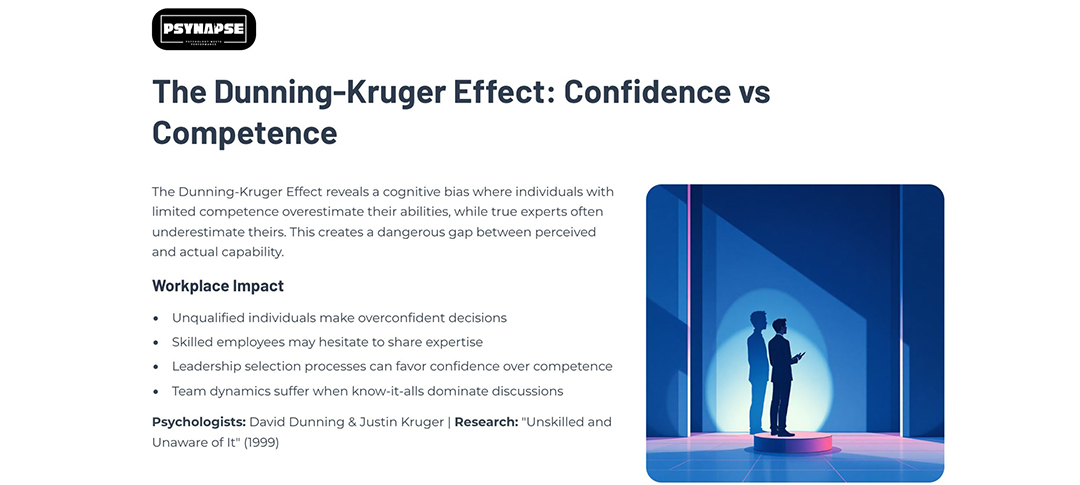
- The Dunning-Kruger Effect (The Confidence Gap) There is a dangerous period where a new people leader doesn’t know what they don’t know. Because they were so successful as individual contributors, they often overestimate their natural ability to lead. They assume leadership is ‘common sense’ skipping the very training that would provide them with the “flight hours” they need.
In the cockpit of US Airways Flight 1549, Captain Chesley ‘Sully’ Sullenberger didn’t save 155 lives through ‘natural instinct.’ He did it through
thousands of hours of simulated crisis training. When the birds hit the engines, he didn’t have to ‘wing it’ – his training took over.
Today, People Leaders are flying Organisation’s most expensive assets – it’s people. According to Gallup, people leaders account for
70% of the variance in team engagement. When crisis hits – a missed KRA, a talent poaching attempt, or a cross-functional conflict – an untrained People Leader defaults to micromanagement or ‘Command and Control’. They lack the strategic empathy required to glide the team to safety.
The Discovery: Identifying the skill gaps. It is time to stop treating management as a merit badge. The Center for Creative Leadership (CCL) identifies three ‘Invisible Gaps’ that drain Indian balance sheets:
- The Identity Crisis: Shifting from “I am the expert” to “I am the enabler.”
- Psychological Safety: Creating an environment where mistakes are reported early, not hidden until they become liabilities.
- The Feedback Paradox: Moving from annual post-mortems to real-time coaching.
Organisation’s management ought to stop treating line management as a merit badge. It is a completely distinct trade, one that requires understanding of the current capability (or mindset/skill-set gap) followed by active learning intervention. Simple steps such as pre-onboarding (similar to new joiner onboarding programs) can help Organizations move in right direction.
- Pre-boarding: Identify leadership potential before the vacancy exists.
- The 90-Day Sprint: Intensive immersion across five Pillars (EQ, Feedback, Conflict, Delegation, and Inclusive Leadership).
Technical experts build products. Trained ‘People Leaders’ build steady Organisations.
In 2026, the cost of an “Accidental Manager” is a price no Organisation can afford to pay. It’s time to move from ‘Trial by Fire’ to ‘Lead by Design’.
The purpose for this article is to leave you with simple food for thought – If you wouldn’t trust a mechanic (technical expert) fly your plane, why would you permit untrained experts lead your organisation’s future?
The cockpit is open. Is your captain ready, or just “accidental”?