We all know the script.
A leader is promoted to the next level or hired to fill a crucial role. The appointment is celebrated and congratulatory messages float around. The press release goes out. All-hands meeting is scheduled. LinkedIn announcement racks up hundreds of ‘likes’ and “congratulations” comments. Everyone agrees – it’s a brilliant choice and a great opportunity.
Then comes
month six!
While the management celebrates ‘perfect fit’, data is whispers a different story. Statistically speaking, there is a
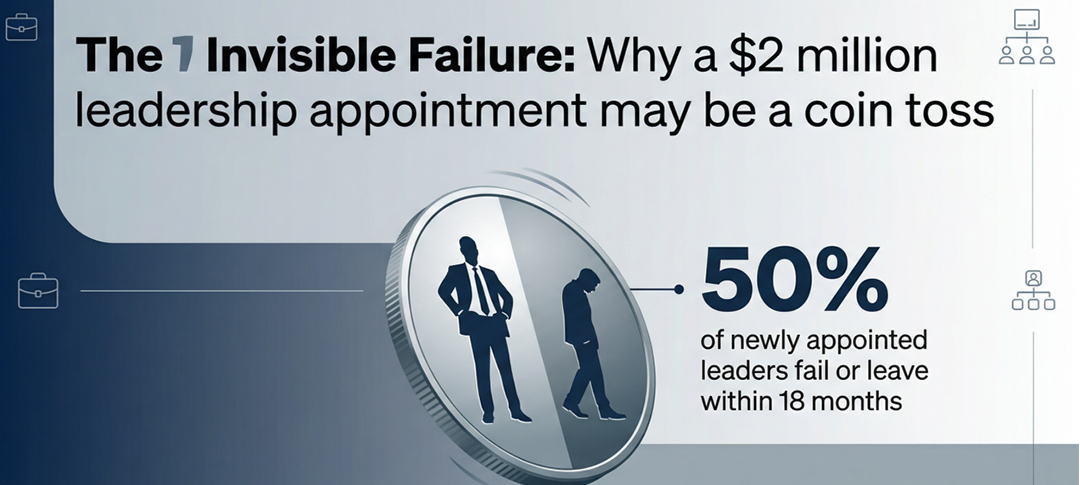
50% chance that a newly appointed leader/ or executive – whether hired externally or promoted from within – will fail or leave within their first 18 months (
Avenue Leadership). HBR 2017 confirms that “61% of executives told us they were not prepared for the strategic challenges they faced upon being appointed to senior leadership roles. It’s no surprise, then, that 50%–60% of executives fail within the first 18 months of being promoted or hired.”
Let that sink in – One in two. Flip a coin.
50%!!
Across every industry, at every level of seniority, this statistic has remained stubbornly consistent for decades – the current success rate of executive and leader transitions across the globe. We don’t often talk about this at the welcome party, but the cost of this -18-month trap is staggering.
Research shows the financial impact of an executive failure runs to
10 times their annual salary (Avenue Leadership).
For example, if the leader is hired at $200k, a failed transition just doesn’t lead to the salary loss but a loss of
$2 million caused by failed strategy, stalled progress, attrition in the teams in the layers below and cultural disengagement, not to forget the ‘
psychological damage’ caused by it. What does the management do when this happens – they quietly absorb the hit and restart the process of looking for another leader.
Why does this happen? Most assume the leader “didn’t have what it takes” however, research confirms otherwise.
Leadership IQ tracked 20,000 leadership appointments and found that
56% of transition failures were traceable to
Emotional Intelligence (EQ) – not a lack of technical skill.
The failure wasn’t hidden. It was visible, measurable and present before the contract was even signed.
So much time is spent looking at the “What” (competencies) that organisations often ignore the “How” (mental and emotional architecture/readiness) of the leader about to move into a newer role.
Just handing over the baton to the newly transitioned leader and hoping for the best doesn’t cut it. It’s essentially what follows post the leader assumes office – month six to 12, when the “identity disruption” of the new role meets the crushing pressure of enterprise expectations that the newly transitioned leader’s
old operating system re-emerges.
Leaders who have undergone recent transitions,
unfortunately revert to the behaviours that made them
successful in their old role, when faced with challenges of the new role. This is one of the fundamental reasons for the transition’s failure.
Success isn’t a roll of the dice. When done the right way, the impact is exponential. Research confirms that
90% of teams with a leader who successfully navigated their transition met their three-year performance goals (
Avenue Leadership) that further leads to:
- Significantly lower attrition
- Higher discretionary effort
- Increased revenue growth (Avenue Leadership)
The variable isn’t talent, pedigree, or the quality of the head-hunter/recruiter or even the job description.
It is ‘Transition Readiness’. It’s about whether a leader’s mind (mental and emotional) is genuinely prepared for what the new role demands of them before the first crisis hits.
Thankfully, the 18-month window isn’t a mystery; it’s very much a preparation (
the act of getting ready for the demands of the new role) problem and study confirms that it is entirely SOLVABLE.
In a world where leader/executive failure costs
10x the annual salary, transition readiness is no longer a ‘nice-to-have’ HR initiative. It is perhaps the most consequential financial and cultural investment that an organization must invest in.
This week’s newsletter goes deep on what Transition Readiness actually looks like—and how to protect your Organisation’s critical leadership appointments.