The
KPMG – AIMA Women Leadership Survey 2026 reveals that there is a surge in women’s ambition towards leadership roles, however, the current organizational structures are still operating on an outdated blueprint, unable to match the speed of growing aspirations. This is a systemic paradox that cannot be solved in silos
As a Business Psychologist, I’ve spent majority of my career decoding behavioural patterns that drive success particularly focussed on #WomenLeadership with some spectacular results. Here is my analysis of the KPMG-AIMA Women Leadership Survey 2026 report on gaps identified and the journey ahead, through the lens of behavioural science.
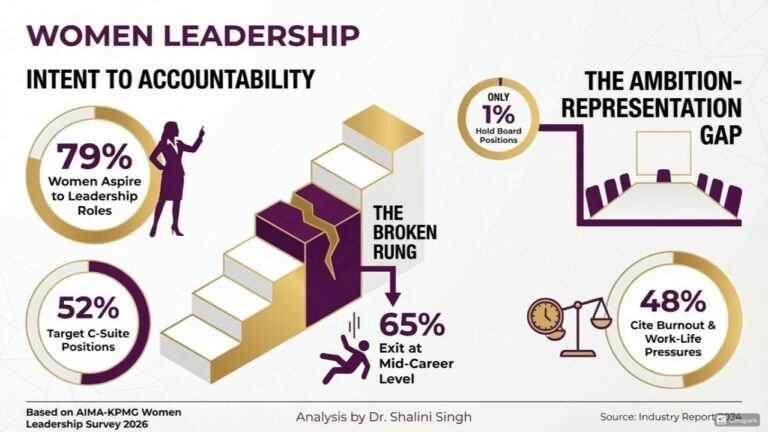
The Ambition-Representation Gap – The desire to lead is undeniable:
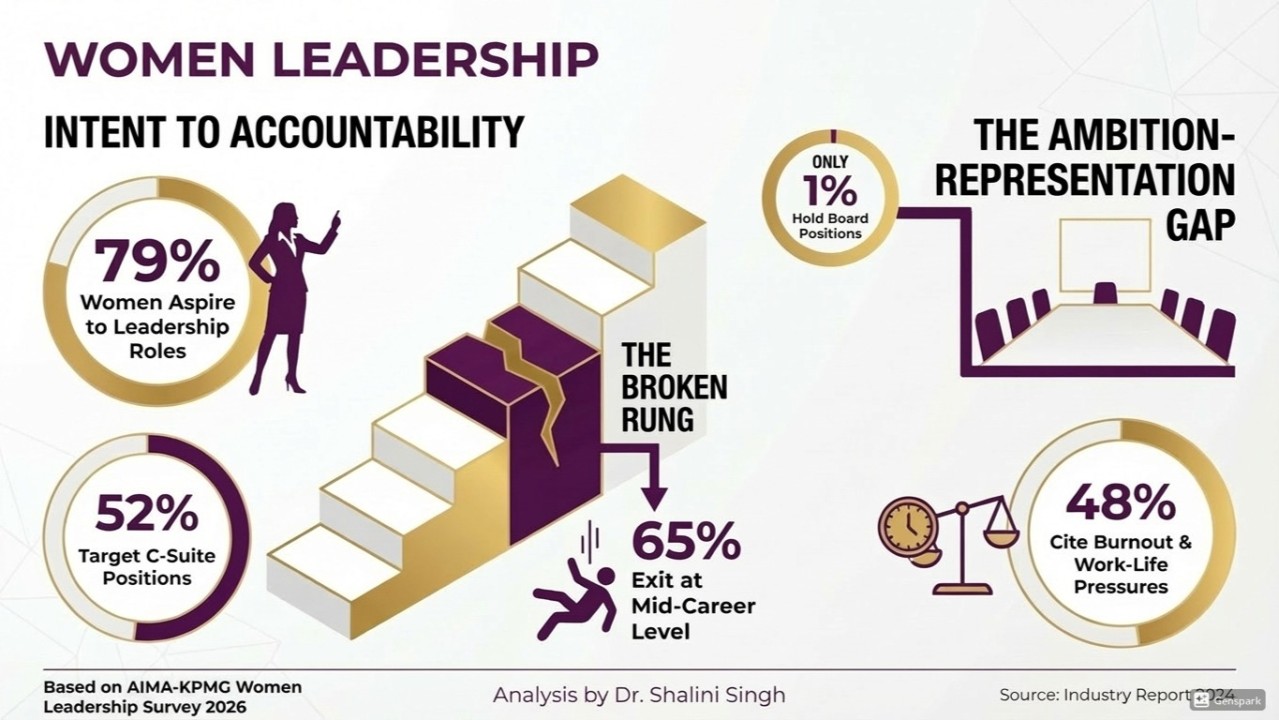
79% of women aspire to leadership roles, with 52% specifically targeting the C-Suite. Yet we are hitting a staggering glass ceiling where only
1% currently hold Board-level positions. The reason
#broken rung at mid-career is aptly reported in the survey as well as in my doctoral research around ‘Women & Leadership’. It is the #broken rung where
65% of women at senior and middle management are most likely to exit corporate careers. Data from exit interviews and informal coffee conversations suggest that these exits aren’t just personal choices but, on most occasions, reactions to Organisational systems and Cultures, where #burnout and #work-life pressures (48%) have surpassed traditional caregiving as the #primary #barrier to staying back.
Plausible solutions to this glaring situation is twofold – i) to understand #keyskills that Organizations today identify as critical enablers of execution-driven leadership and ii) to have Organizations co-create with intentionality:
- Results & Accountability (12%): The top-rated skill for driving tangible success
- Collaboration & Teamwork (11%): Essential for leading in a fluid, hybrid world
- Communication & Influence (9%): The ability to build credibility and shape strategic outcomes
- Adaptability & Resilience (8%): Navigating the uncertainty of rapid technological change
- Inclusive Leadership: Inclusion, Diversity & Equal Opportunity (5%) is no longer a nice-to-have – it is a core leadership requirement
To match intent and accountability, Organizations and employees ought to go beyond just #upskilling as the responsibility doesn’t just lie with those aspiring to get to the top-job or ‘fit into a system’ that wasn’t built for them to begin with. It is recommended that Organizations co-create the infrastructure for intentional growth for high potential women talent by:
- Moving from Mentorship to Sponsorship: While 59% of organizations offer mentorship, the need of the hour is formal sponsorship – active advocacy by senior leaders who provide high-impact stretch assignments and visibility in strategic forums.
- Rebuilding trust through transparency: Only 28% of employees view current evaluation processes as fair. It’s time to co-create transparent, standardized assessment mechanisms to eliminate the ‘proximity bias’ that often favors the other gender.
- Redesigning roles for sustainability: Leadership shouldn’t require ‘constant availability’. Roles must be redesigned with flexibility and shared accountability to prevent mid-career attrition.
Audit for equity: Trust is built on proof and routine audits of pay parity and promotion rates are essential to move from ‘intent’ to ‘lived reality’.
By co-creating these pathways, Organisations can look to move from being ‘aspirational’ to being ‘accountable’.
To conclude this analysis, I’d say, it is time to stop viewing women leaders as a ‘deficit to be corrected’ and get Organizational systems and Cultures invested in creating platforms that are redesigned… with intentionality.
I look forward to having a conversation – formal or informal, if you are equally #passionate about making a difference and playing your part as a #Leader, #Ally or a #Champion in addressing the present and co-creating the future.